



Our concept: Stallion husbandry . . . with a difference
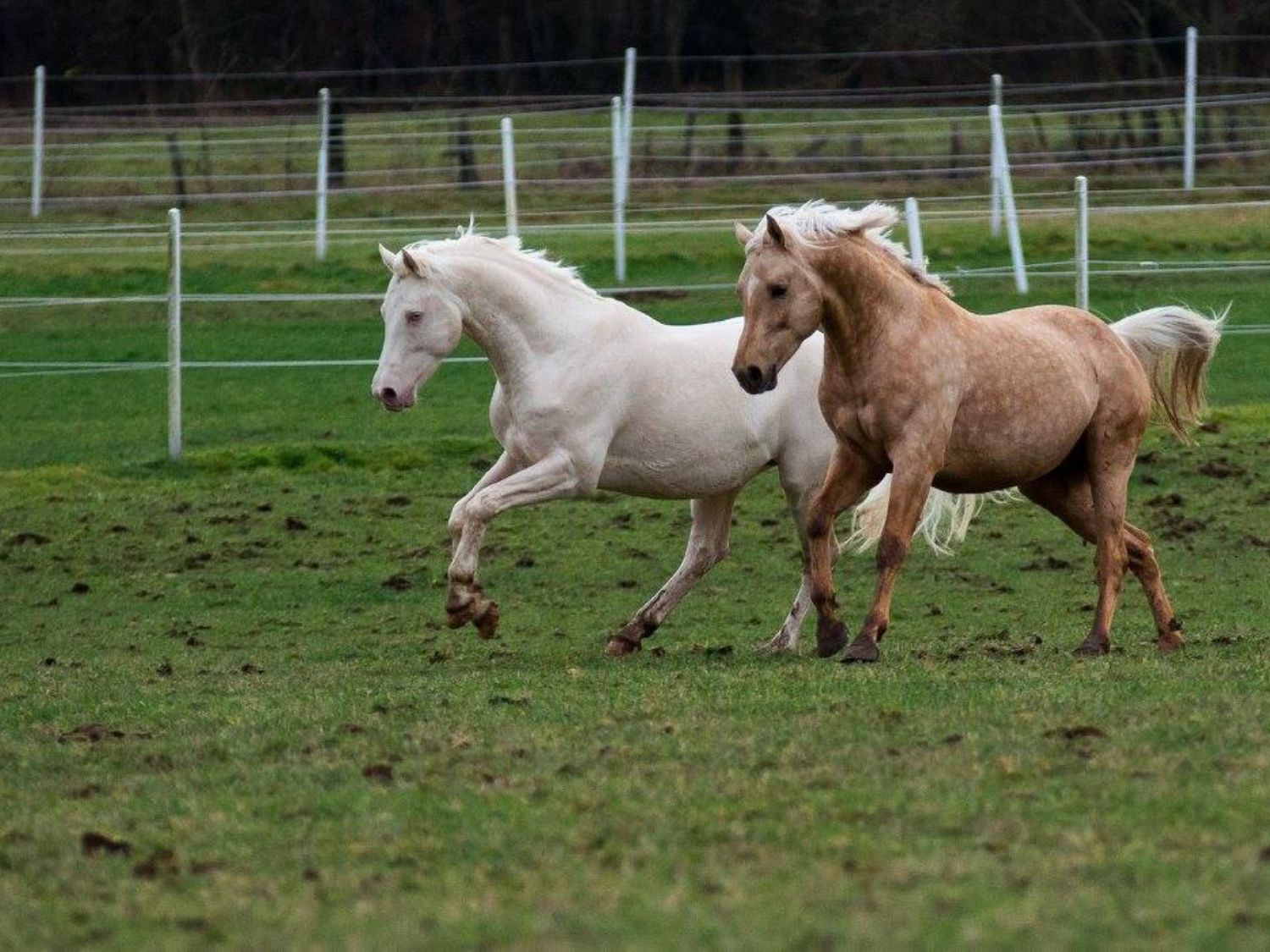
At the end of 2009, our dream began to become reality. We bought an old estate with a house, stable, barn and several hectares of pasture and arable land right next to the farm. Our goal was to raise our own and pensioned stallions in a species-appropriate manner and to allow them to live harmoniously together in groups and year-round grazing with an open stable even when they are old enough to breed and compete. This resulted in a 150 m² open stable with various resting and feeding areas, and an adjacent spacious 100 m² paddock with access to a 200 m² sand rolling and lying area. Adjoining this are the entrances to the various pastures, so that year-round grazing is possible.
In addition to a horse walker, a treadmill and several solariums, we have a brine inhalation Viatal box to ensure that the horses are well in every respect. Our facility was awarded four stars straight away in the initial certification by the Laufstall-Arbeits-Gemeinschaft eV for species-appropriate horse husbandry. From weanlings to old stallions, our own stallions and several breeding stallions live in a common herd.
We work closely with a hoof orthopedist to ensure the continued well-being of the stallions. Our vet also regularly carries out selective/up-to-date deworming, and new horses must be selectively dewormed before delivery by means of a stool sample test. Regular preventative examinations by our horse dentist are also part of our services, as is the six-monthly assessment and treatment by our horse osteopath.
Our species-appropriate husbandry of stallions in detail
"Species-appropriate" is probably the buzzword in the horse sector today. Above all, it means that species-appropriate housing, upbringing, training and, last but not least, feeding are not neglected. But is the horse, and particularly the stallion, always well-being taken care of? Breeding or housing errors can have extremely serious consequences for stallions.
Stallion owners are subject to much more social constraints than owners of mares or geldings. The general opinion is that stallions are vicious, unruly and uncontrollable, and that keeping them alone and only letting them out on paddocks for a few hours at most is acceptable. It is very difficult for the average horse owner to keep stallions in the best possible way. The space and organization of a day in the stalls alone make different demands than for geldings and mares. Most stallions today have a very sad existence in a barred solitary confinement of 3 x 3 m, with a window if you are lucky, so that you can occasionally take a sad look outside. The only change in the day is the ride/excursion and feeding in the morning and evening. This is by no means ideal. There are other ways, but for that you don't have to worry about keeping the stallions in a species-appropriate manner, but rather about the stallion's natural behavior.
This concept of species-appropriate husbandry is so superficial that it is unavoidable to look at it more closely. There are enough studies and relevant literature that describe the natural habitats and, as a result, the natural behavior in intact herds and so-called bachelor clubs. And one thing is certain: our domestic horses today are no different in this respect from those that lived in the wild in the past or today. Horses are herd animals, and stallions live happily in a herd of mares or in a mixed stallion-gelding group. There are certainly isolated and very rare animals that do not exhibit any social behavior. It remains to be seen whether this is due to heredity or breeding errors or even husbandry errors.
Pure movement, such as when playing, depends on the composition of the group, age and also the weather and amounts to 3-15 percent of the day. For our stallions, just like for all other horses, species-appropriate means being kept in the company of other horses, with opportunities to satisfy their need to run (without rider and driver) and escape behavior and ultimately also active participation in the wider environment. Our stallions live with us in an open stable with movement incentives based on modern behavioral research - which cover the following basic needs of a horse: - light - air - continuous movement - social contact - regular food intake. They are freely exposed to the environmental and thermal stimuli of the individual seasons all year round and can decide for themselves whether they want to stay in the pastures, in the large indoor run-in stable, or whether they want to retreat to the "chill-out box".
A horse in the wild covers between 15 and 20 kilometers a day. This confirms that a horse is a running and flight animal with a great need for movement. Continuous movement contributes enormously to keeping the horse healthy. The musculoskeletal, digestive and respiratory systems stimulate numerous blood circulation and metabolic processes. Synovial fluid is released through movement, which lubricates and nourishes joints. Bones maintain the necessary stability under movement and stress, and tendons and ligaments are strengthened. Our stallions can always decide for themselves when, where and how they want to move.
Our pasture concept with four independent pastures allows us to leave some pastures alone at any time, to maintain the pasture and to release others for grazing. All pastures can be accessed or closed off through gates and entrances from the stables. The rolling and lying area made of sand is just as inviting for playing and relaxing after a long sand bath as the spacious pastures, which in turn promote the equilibrium of the horse. This means that our stallions can romp and let off steam on sufficiently large pastures, that they can experience rain and snow and can decide for themselves where they want to stay. In summer, the horses usually go out to the pastures at night to escape the high temperatures and flies during the day.
The stallions can decide for themselves whether and for how long they want to stay in the pasture to eat grass, and when they want to go back indoors to eat roughage or quench their thirst. Since horses live in small family groups in the wild and this existential drive is still present today, our stallions all live in a common herd. Regardless of whether they are weanlings, yearlings, competition stallions or stud stallions - they all form a harmonious herd community. Life in the herd also offers a certain protective function, opportunities for activity, has a huge impact on the character of a stallion and also creates an incentive to run.
Even today, horses still have a feeding instinct, which means that they are constant eaters. In the wild, horses eat for up to 16 hours a day. They move continuously, which ensures smooth digestion. The horse's entire digestive system, with its small stomach and long intestine, is geared towards the most continuous intake of small amounts of feed containing crude fiber. Our stallions are given small amounts of concentrated feed several times a day and unlimited hay and straw to freely consume. In order for a horse to feel full, it must be able to chew for at least 12-16 hours a day. Indoors, several mineral and salt licks are offered, but tree trunks are also available for nibbling. Training a stallion is a tricky business, because a stallion will challenge its owner's position as alpha animal far more often and more forcefully than a mare or gelding will try. In any case, expertise and specialist knowledge with the necessary sensitivity are required.
The subtle difference between the sexes is already clearly evident in foal age. This is where the foundation is laid for proper training, which is so important and essential for the stallion in later (breeding) age. This is why stallions should be introduced to halters and hoof-giving in a playful way from the earliest age. Our stallions are each tied up in their “own place” with a halter and rope at mealtimes. This ensures that each can take in and eat their individual amount of feed in peace. At the same time, the stallions associate haltering and tying with something positive; they see the connection haltering + tying = feed. This also teaches them to remain relaxed and tied up after they have finished eating until the last horse has finished eating in peace. A securely fenced pasture is just as important, both in terms of the fence itself and the height of the fence. Our fences are fenced with plastic posts and provided with 3-fold or 4-fold strands made of UNI-Perm (carbon fiber coated steel core) and Uni-Cord (cord with 5-leading strands).
The stable must also be safe and free from any risk of injury. Some will now say that this also applies to horses in general, but it is undisputed that stallions are definitely more inventive and capable of greater intelligence than mares or geldings. Starting with opening door locks that are - if you can believe the industry - absolutely escape-proof, to unscrewing feed bins and simply jumping out of half-open stall doors. Our indoor feeding grids ensure that roughage is accessible around the clock and is not contaminated by urine and feces. Just let him be himself until he is the same age as mares or stallions that have already laid, and he should have just as much time to grow up as his peers. Optimal rearing is the guarantee for a successful career as a breeding and sport horse.
We offer boarding places in accordance with the guidelines for assessing horse husbandry from an animal welfare perspective in species-appropriate, spacious open stables with paddocks, as well as healthy development in the following years on our extensive pastures. Growth, muscles and bone structure are promoted and strengthened under favorable climatic conditions and meticulous control.
You think that's not possible?
We would be happy to show you our LAG **** facility, convince yourself and come and visit us by arrangement.








1 comment
Dieter harisch
Hi aus Bayern 6l ihr Konzept finde ich sehr gut. Ich selbst hatte Pferde seit ca
50 Jahren
Begann mit einem trakehjer/Araber und ging dann zu einer quarter Stute daraus hatte ich fohlen gezogen dann sagte mir freund ( Traber Trainer)) dssxdervtrsber d aollras beste Reitpferd sei. darauf besorgte ich nmir 3 Traber. Die tölteten allle total und wer mal den cowboy Cadillac geritten hat der steigst auf Kein anderes Pferd mehr.
Jetzt mal zu einer Frage : Ich würde sie gern mal besuchen
Ich war viele Jahre im ha als soldat im Harz und in wieda Bund meine Frau hab ich aus Tetttenborn – Kolonie mõõt nach Bayern genommen
Frage haben sie fremden zimmer zu u vermieten?.? Falls ja bräuchte ich
1 X EIN. DZ UND 1 X 1 EZ
Termin wäre Ende März bois de ende April für ca 6 Tage gesamt
Puuh das war ein langes mail und bin heilfroh dass ich das ding nicht versaut habe
Grüsse aus dem bayerischen schwobaländle
Dièter harisch
0174 34 66345
FINKENWEG 15
89257 illertissen
Hi aus Bayern 6l ihr Konzept finde ich sehr gut. Ich selbst hatte Pferde seit ca
50 Jahren
Begann mit einem trakehjer/Araber und ging dann zu einer quarter Stute daraus hatte ich fohlen gezogen dann sagte mir freund ( Traber Trainer)) dssxdervtrsber d aollras beste Reitpferd sei. darauf besorgte ich nmir 3 Traber. Die tölteten allle total und wer mal den cowboy Cadillac geritten hat der steigst auf Kein anderes Pferd mehr.
Jetzt mal zu einer Frage : Ich würde sie gern mal besuchen
Ich war viele Jahre im ha als soldat im Harz und in wieda Bund meine Frau hab ich aus Tetttenborn – Kolonie mõõt nach Bayern genommen
Frage haben sie fremden zimmer zu u vermieten?.? Falls ja bräuchte ich
1 X EIN. DZ UND 1 X 1 EZ
Termin wäre Ende März bois de ende April für ca 6 Tage gesamt
Puuh das war ein langes mail und bin heilfroh dass ich das ding nicht versaut habe
Grüsse aus dem bayerischen schwobaländle
Dièter harisch
0174 34 66345
FINKENWEG 15
89257 illertissen